There is a moment at almost every military funeral when the room goes still. The first note of Taps carries across the cemetery, and a family that has held itself together all morning finally exhales. Military funeral honors are built around a moment like that one. They are brief, they are exact, and they say something a eulogy cannot.
If you are planning a service for someone who served, you probably have practical questions. Who performs the ceremony. What the family is asked to do. Whether your loved one qualifies at all. Here is what actually happens at a military funeral, and how the honors get arranged.
Military Funeral Honors Are a Right, Not a Favor
Military funeral honors are guaranteed by federal law. Section 578 of the National Defense Authorization Act for fiscal year 2000, enacted as Public Law 106-65, directed the Department of Defense to provide a military funeral honors ceremony for every eligible veteran whose family asks for one. That requirement took effect on January 1, 2000, and it created the military funeral honors program the branches still operate today.
The law sets a floor rather than a ceiling. At a minimum, the funeral honors detail consists of at least two members of the armed forces, at least one of them from the branch the deceased veteran served in. The detail folds and presents the American flag to the next of kin and sounds Taps. Anything beyond those two elements depends on what a branch can send that day, and there often is more.
Because military funeral procedures are standardized across the services, a service in Grantsville looks much like one held anywhere else in the country. Families tend to find that reassuring. Nothing about it is improvised.
Who Qualifies for Military Funeral Honors
Eligibility is broader than most families expect. Honors are available to military members who die while on active duty, to a veteran who served on active duty and was discharged or released under honorable conditions, and to members and former members of the Selected Reserve who meet their service requirements. Commissioned officers of the Public Health Service and the National Oceanic and Atmospheric Administration may qualify as well.
A person is not eligible if the discharge was under dishonorable conditions, if he or she was convicted of a federal or state capital crime, or if the secretary of the relevant military department has otherwise barred honors.
One term of enlistment is often enough. There is no requirement of combat, no requirement of a long career, and no requirement that the death be connected to military service. Peacetime service qualifies. So does service from decades ago that the person rarely spoke about.
What Happens During a Military Funeral Honors Ceremony
Honors are usually rendered at the graveside or at a committal shelter. At a VA cemetery the committal typically runs about twenty minutes, and at a local cemetery the funeral director coordinates the timing so that the honors follow the graveside remarks. Here is the sequence most families see.
The casket arrives. A flag draped casket is carried to the site, with the blue field over the left shoulder of the deceased. When there has been a cremation, the folded tricorn is displayed beside the urn instead.
The detail takes position. The uniformed military personnel stand at attention through the committal and hold a slow salute during Taps.
A rifle salute may be fired. Three volleys from a firing party are the sound most people associate with a military funeral, although the volleys are not required by law. They are usually provided by a veterans service organization or a state honors team rather than by the two person detail. Some teams gather the spent casings and tuck three of them into the folds before the presentation.
Taps is sounded. Twenty-four notes, played by a live bugler when one is available and by a ceremonial bugle when one is not. It lasts under a minute and it is the part nearly everyone remembers.
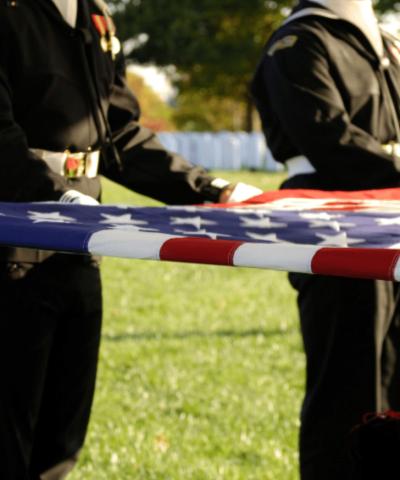
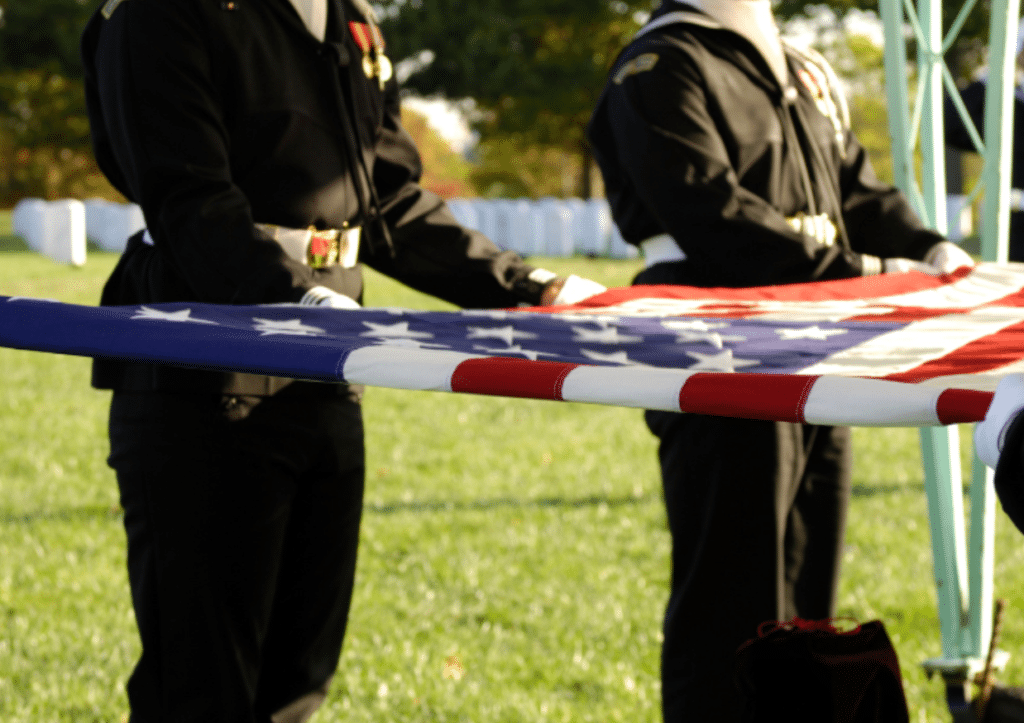
The flag is folded. Thirteen folds turn it into a tricorn shape with only the blue field and white stars showing. The fold is slow and deliberate on purpose.
The flag presentation. A service member kneels in front of the next of kin and speaks words set by the branch. On behalf of the president of the United States, the branch of service, and a grateful nation, please accept this flag as a symbol of our appreciation for your loved one’s honorable and faithful service.
Families are often surprised by how quiet and personal that last moment feels after the precision of everything before it. There is no wrong way to receive the flag. You can hold it, weep, or say nothing at all. The honor detail will wait.
Who Actually Renders the Honors
Every branch runs its own program. The Army, Marine Corps, Navy, Air Force, Space Force, and Coast Guard each maintain funeral honors coordinators who assign teams by region. In Utah, a large share of these requests is filled by the National Guard, whose honors teams cover Tooele County and the communities around it.
Veterans service organizations fill the gaps. Local posts of the American Legion and the Veterans of Foreign Wars supply buglers, firing parties, pallbearers, and color guards through an authorized provider partnership with the Department of Defense. When a family sees a full honor guard detail at a small town funeral, volunteers who served are usually the reason. That is a quiet kind of duty, performed for strangers, week after week.
How to Request Military Honors for a Loved One
Ask your funeral director. That is genuinely the whole answer. The funeral home contacts the honors coordinator for the correct branch, confirms eligibility, and schedules the honor detail around your service time. Requests should reach the branch at least 48 to 72 hours ahead, which is one more reason not to delay the first call to a funeral home.
You will need proof of service. The DD Form 214, the Certificate of Release or Discharge from Active Duty, is the standard document. If the family cannot locate it, copies can be requested from the National Archives through its online records request or by mailing Standard Form 180. Older files can take weeks, so start looking early. Staff at a VA national cemetery can also help arrange a military honors ceremony, and so can a local post near you.
Honors That Continue After the Funeral Service
The ceremony is one piece of a wider set of benefits administered by the Department of Veterans Affairs.
A burial flag is furnished at no cost for qualifying service. Families apply with VA Form 27-2008, and funeral homes, VA regional offices, and many post offices keep the form on hand. This is the flag that drapes the casket and is later presented to the family.
A Presidential Memorial Certificate, an engraved certificate signed by the sitting president, is available to the next of kin and to other family members and close friends through VA Form 40-0247. Many families request extra copies so that each child or grandchild has one.
The National Cemetery Administration furnishes a headstone, a grave marker, or a bronze medallion for a private headstone, and it operates the federal cemetery system. A federal cemetery opened in Cedar City in 2025 and serves the southern part of the state, while Utah also runs a state cemetery, the Utah Veterans Cemetery and Memorial Park in Bluffdale. Arlington National Cemetery has its own eligibility standards and scheduling process and is administered separately.
Burial in a federal cemetery is not a condition of anything. A veteran can be laid to rest in a family plot in Grantsville or Tooele and still receive full honors.
Cremation and Memorial Services Count Too
Honors are not limited to a traditional burial. A family that chooses cremation can still request the entire ceremony, rendered beside the urn. Honors can also be rendered at a memorial gathering held weeks later, at a church, or at a graveside months down the road when relatives are able to travel. Ask even when the timing seems unusual. The service being recognized does not expire.
Small Things Families Wish They Had Known
Decide in advance who receives the flag. It is presented to one person, and that is not a decision to make while a detail waits at attention.
Let the children stand close. Kids remember the fold and the bugle for the rest of their lives.
Bring sunglasses. Cemeteries are open and bright, and grief is easier when your eyes are your own business.
Tell us about the years in uniform. A branch insignia on the program, a photograph from basic training, or a favorite story from a deployment turns a standard funeral into that person’s funeral.
Arranging Honors With Dalton-Hoopes
Dalton-Hoopes Funeral Home has cared for families in Grantsville, Tooele, Stansbury Park, and the surrounding communities since 1979, and coordinating military funeral honors is a regular part of what we do. We confirm eligibility, track down discharge paperwork, contact the branch coordinator, and work with local volunteers so that the honors your family receives are complete and unhurried.
Whether you are planning ahead for yourself or you have just lost someone who served, we are here. Reach us anytime at daltonhoopes.com/contact-us/. Every eligible veteran has earned this farewell, and we will see that it is done right.